More Bahamian airports privatized and airport fees increased
For approximately the last 10-15 years, The Bahamas government has increased fees and added new fees on general aviation operators flying to The Bahamas for tourism. The reasoning had always been that the revenue was needed for airport improvements. Throughout those years the only improvement project we were able to verify was the runway at the Staniel Cay airport (MYES) in the Exuma Islands.
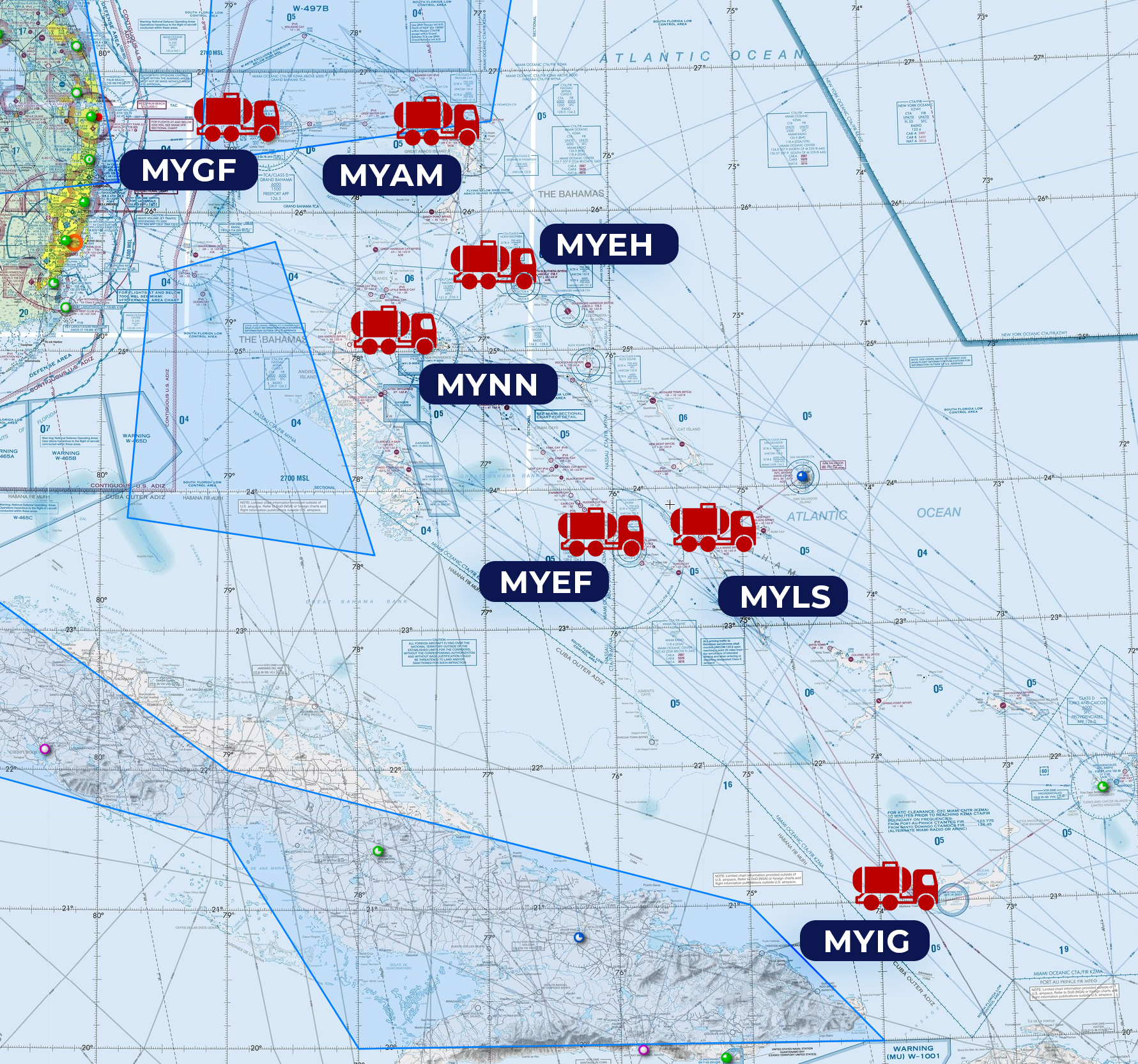
On March 01 of 2023, the Bahamas Airport Authority initiated a request for proposals from private companies to redevelop and manage fourteen Family Out Island airports on a 30-year agreement. Amongst the fourteen airports included were the North Eleuthera International Airport (MYEH), Governor’s Harbour International Airport (MYEM) and the Exuma International Airport (MYEF). Two of these three airports are strategically important to general aviation because they are not only international airports, but MYEH and MYEF each have Jet A and AVGAS fuels. There are only 7 airports in The Bahamas with aviation fuel, including Nassau (MYNN) and Freeport (MYGF) which have heavy traffic and are not ideal options for just a fuel stop. Great Inagua (MYIG) is located at the extreme southern end of The Bahamas and is not a popular destination which also makes it impractical for most operations. This only leaves Marsh Harbour (MYAM) to the northeast and Stella Maris (MYLS) to the southeast as other options for fuel availability.
This week we learned through several sources, which was confirmed by the Nassau Tribune newspaper, that the same operator who took over the Bimini International Airport (MYBS) in May of 2024, Bimini Airport Development Partners (BADP), was taking over these three airports as well under the name of Island Airport Development Partners (IADP). It was commonly observed, and reported, that the fees at MYBS went up significantly after the takeover by BADP in 2023.
Additionally, we also learned of a pricing schedule for all aircraft operations at MYEH, MYEM and MYEF which SIGNIFICANTLY increases the cost of operating at these three airports. We modeled a Pilatus PC12 and a Hawker 800 each with four passengers staying for four nights on an international arrival and departure to/from MYEM. First, we estimated the costs of these two scenarios using the actual 2026 fees in place today and then we compared the same scenarios with the new 2027 fees that IADP is reportedly planning for these three airports starting January 2027. The costs of each scenario increased by 84% for the PC12 and 92% for the H25B. There are also additional new, significant fees for domestic operations for those operators planning inter-island flights to/from MYEH, MYEM and MYEF.
The strategic location of these four privatized airports with higher fees; MYBS, MYEH, MYEM and MYEF, and the fact that two of them are amongst the few options for fuel in The Bahamas, implies that general aviation operators should be prepared to either pay significantly more for airport fees or reconsider their destinations. Additionally, those operators planning to use these airports as refueling stops should be prepared to pay significantly more for their airport fees or choose Marsh Harbour (MYAM) or Stella Maris (MYLS) as alternative options for refueling.
The great unknown now is what impact this privatization will have on the existing FBO’ s in MYEH and MYEF. We fully expect these fees to apply at these airports even if an operator uses the FBO terminal and ramp, so the increases will pass through to everybody using the airport. The remaining question is whether IADP will increase the rents that these FBO’s have to pay the airport operator which will in turn force the FBO’s to also have to increase their fees as well. This would have a doubly negative impact on operating costs at those airports.
It is important to note that there are still additional airports on the list of fourteen airports that the Bahamas Airport Authority is wishing to hand over to private operators which could mean that fee increases could continue to spread across The Bahamas. Another important observation is that these fees not only affect general aviation but also commercial airlines as well which impacts the ticket prices that local Bahamian citizens wishing to fly inter-island will have to pay.