
How an obscure Bahamas Company may add $1,550 to your trip
This private entity could affect hundreds of thousands of General Aviation and Commercial flights that overfly The Bahamas by adding $ 1,550 USD of cost to their round-trip flights to the Caribbean and South America. This fee is separate and different from the fee imposed by the Bahamas Air Navigation Services Authority (BANSA) reported separately.
The Bahamas Aviation, Climate and Severe Weather Network Ltd. (BACSWN) appears to be associated with another entity called “Sky Miles Limited” (not to be confused with the Delta Airlines Skymiles company). BACSWN’s founder is acknowledged to be related to one of The Bahamas’ largest newspapers. Interestingly, BACSWN’s Chief Operating Officer is also reported to be The Bahamas’ non-resident ambassador to ICAO.
BACSWN’s stated purpose began primarily as a weather-observation and visualization initiative and has expanded into aviation surveillance, meteorology, climate monitoring, emergency medical services, education and commercial carbon-credit development. Many of these stated activities appear to overlap with those of existing Bahamas Government agencies such as Bahamas Air Navigation Services Authority (BANSA), Civil Aviation Authority Bahamas (CAAB), Bahamas Department of Meteorology, Bahamas Airport Authority, Bahamas Defense Force (SAR) and Bahamas Ministry of Health. It is not clear how this private entity would interact with the authorized government entities and how that interaction will affect aviation operations.
It has been reported by The Tribune in Nassau, Bahamas and by The Bahamas government that BACSWN and the Government of The Bahamas signed a Heads of Agreement on May 7, 2025. The agreement reportedly authorizes a three-year, $427 million USD program involving aviation weather, meteorology, aircraft surveillance, environmental monitoring and emergency-response services. In addition, the US National Oceanic and Atmospheric Administration (NOAA) has signed an agreement with Sky Miles Limited to develop and install an advanced aviation forecast system covering The Bahamas for a fee of $ 728,000 USD.
To fund this endeavor, BACSWN is pursuing ICAO approval to charge a $775 overflight fee with $500 going to The Bahamas government and the remaining $225 going to BACSWN. It is unclear if this new BACSWN fee is in addition to the existing BANSA overflight fee or if the BACSWN fee replaces it. There is also no specific language as to what aircraft would be subject to the fee or if flights to/from/within The Bahamas will also be subject to the fee.
The following chart shows the existing BANSA charging airspace which effectively includes airways from south Florida head to the Caribbean and South America. To our knowledge, it has not been established if this area would also define the airspace and airways subject to the proposed BACSWN fee. Aircraft operating through this block of airspace could effectively be subject to a $775 USD fee, each way, for a total of $ 1,550 USD round-trip. Comparing this fee to that of other FIR’s in the area, the BACSWN fee is significantly greater than any other FIR. Operators departing the southeast US might want to consider routes from NUCAR to the north of this airspace so as to intercept an airway east of this region or instead obtain a Cuban overflight permit and overfly Cuba to the west of this region at a significantly lower cost.
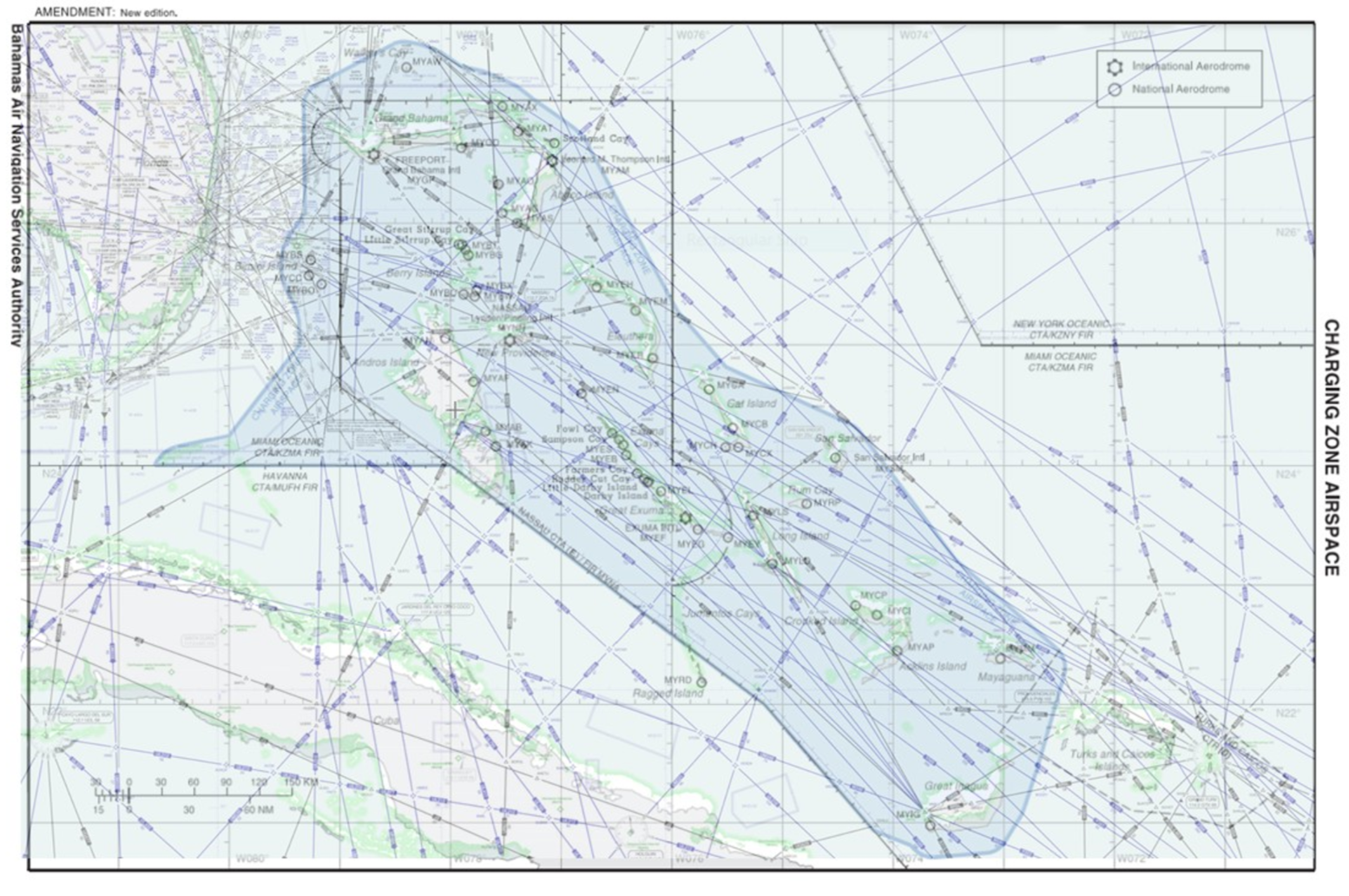
Overlay of BANSA Charging Zone with High Altitude Enroute chart
The obscure nature of BACSWN, the ambiguity of how it will affect interactions with The Bahamas governmental entities, and the extremely high cost of the overflight fee is worrisome. Aircraft operators should monitor this development closely as it could significantly affect the cost and complexity of their operations overflying The Bahamas.