
Survival Strategies

Over Water Flying
While this article was originally written for smaller single-engine piston aircraft, a lot of the concepts also apply to turboprop and jet aircraft as well.
Modern aircraft engines are extremely reliable, so ditchings are rare events and when they do occur, statistics indicate extremely high survival rates. Nonetheless, it is essential to have one's own over-water survival plan in preparation for your trip, and to brief your crew and passengers on that plan before departure. The following are some things that we consider as part of our over-water plan which may be of benefit to you in developing your own.
Planning and preparing for an overwater flight:
Plan routes that keep you over, or close to, land, even though they may be longer. Select higher altitudes to maximize communications range, gliding distance, and time to go through checklists, communicate, and brief passengers in case of an emergency. Traveling early in the day will maximize daylight hours available for a search and rescue.
Perform an extra-thorough pre-flight inspection of the aircraft and verify all fluids are to maximum levels. Carry at least enough fuel to fly to your alternate and still have a minimum one-hour fuel reserve. There are often no points of reference over water, so a GPS with a moving map is a useful aid for situational awareness. In an emergency, it also allows you to provide your precise coordinates to ATC and other aircraft. Leave a personal flight plan with friends or relatives back home, and travel with other aircraft if possible.
Wear dual-cell, constant-wear life vests that have pockets for critical safety equipment. Constant-wear vests eliminate the need to find, open, and put on your life jacket while in the middle of an emergency. If you don't have a vest with pockets, you can store critical safety equipment in survival pouches that attach to your body. Always inflate vests once you are outside the aircraft. Carry a covered dual-cell life raft large enough to carry all the occupants. To aid in rescue, a 406 Mhz Personal Locator beacon (PLB), which transmits a signal directly to COSPAS/SARSAT satellites is essential. PLB’s reduce the size of the search area and the time to locate you. PLB’s can also be removed from the aircraft and transferred to the life raft.
Other survival equipment to consider are: signal mirror, signal flares, whistle, thermal blanket (the silver coating makes for a large area of reflective material), large industrial-grade garbage bag (it provides some heat insulation if you lose your life raft and must get into the water), red plastic streamer that rolls out on the water to enhance visibility, and a waterproof signal light that transmits light in the infra-red range (some search-and-rescue aircraft use night vision goggles). Another important item to consider is having Thermal Fire Containment Bags aboard that can be used in the event of a runaway lithium-ion battery fire. These fires are intense and release large amounts of hazardous smoke.
In addition, carry an emergency equipment bag with: water, food, first aid kit, waterproof matches, sea sickness tablets, sunscreen, mosquito repellent, compass, rope, fishing line & hooks, duct tape, thermal blankets, multiuse knife, marine handheld VHF radio for transmitting on the marine emergency channel 16, and an aviation handheld VHF radio. Other items you may want to consider are a portable reverse osmosis water maker and doses of required medication in watertight containers. Carry your life raft and emergency equipment near the aircraft exit in such a way that it will not hinder exit from the aircraft.
While over water:
Request flight following so that you are in contact with ATC and they know who and where you are. Whenever you see a ship, create a temporary waypoint in your GPS so that you can return to that spot in an emergency. If you ditch near a ship or boat, land in front of them so they see you, but not directly in their path where you could cause a collision if they can't stop.
If the worst were to happen, remember to "Aviate, Navigate and Communicate". Establish best glide airspeed and then set a course for the closest land mass or ship (remembering to take wind speed and direction into account) and review emergency checklists. If you programmed a vessel location into your GPS, then use the GPS to navigate back to that spot. Next, activate the ELT and PLB and squawk 7700. If unable to contact ATC, transmit a Mayday in the blind on 121.5 MHz giving your call sign, position, aircraft type, total number of persons on board, and intentions. Most importantly, brief the passengers.
Loose objects that can cause injury during the sudden deceleration of a ditching should be jettisoned before contact with the water. Open exit doors and wedge something in the doorframe to keep the impact forces on the fuselage during a ditching from jamming the doors closed and preventing them from opening. When you reach 1,000 ft. AGL, don’t forget to secure the PLB and have passengers get into the brace position. Try to ditch parallel to, and preferably on top of, a swell; however, wave action and wind direction may dictate otherwise. You should always avoid landing directly into the face of a swell, as water can act like a brick wall when impacted at high speed.
You should consult with aviation safety professionals and your aircraft POH when developing your own over-water survival plan. There are a variety of sources of information for safety and survival equipment as well as websites with lots of information on over water flying.
Planning for Survival
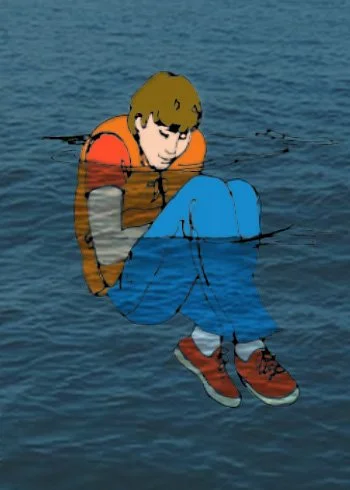
By Randy Boone
The following article was written by Randy Boone, a retired Coast Guard chief with thousands of hours of experience in Coast Guard aircraft looking for downed airmen. We have found that Randy's knowledge and experience can provide a very unique, comprehensive and highly useful resource for pilots wanting to prepare themselves for flying over different types of terrain.
Throughout my training and experience, the thing that stands out most is that everyone knows there’s a chance they can ditch or their boat will sink, but most people refuse to accept that it can happen to them. With that in mind, I’ll list a seven-step survival plan that can save your life in any survival situation.
Recognition
Inventory
Shelter
Signals
Water
Food
Play
Recognition: Yes, an emergency can happen to you. The key to survival is to recognize your emergency and set your plan into motion as soon as possible. In short, get your ego out of the way, admit you are having a problem and get help on the way. This means transmitting a mayday as soon as possible, including your aircraft tail number and type, location (Lat/Long), number of souls on board, survival gear carried, nature of distress, and intentions. Speak slowly and clearly. Before you take off, brief your passengers on egress. Never assume they know how to egress your aircraft. Designate one passenger to tend to the life-raft, another to retrieve water and other survival equipment, etc. Recognition has been found to be the most contributing factor in the success and failure of a survival situation. Without recognition, you will delay your rescue and may not be able to complete the remaining six steps to survival.
Inventory: Review what survival items you have on hand, including the ones that can help you and the ones that can hurt you. This step should take place prior to take-off. Is your life-raft on board? Do you have sufficient life-vests? Do you carry a survival kit with signaling equipment? These are very important items that should be displayed on a “before over-water flight” checklist. Your “before ditching” checklist should include placing the life-raft where it can come out of the aircraft with you. I prefer it either strapped in the seat next to the person in charge of the life raft, or under the front of seat of the designee with legs holding it in position. The person in charge of the life raft should be the first one out of the aircraft and all following crew should make a sweep to ensure that the life raft went out. Once outside of the aircraft, you should inflate your life-vest. The life vest will inflate instantly once you pull the lanyard(s). Take note that entry into a life raft is almost impossible with a fully inflated life vest and you may need to remove all or most of the CO2 prior to life raft entry. Once in the life raft, you can orally inflate the vest to where it feels comfortable (fully inflated may restrict movement and take up extra space). Once all persons are on board, you should open the equipment container and take inventory of all items carried in the equipment container as well as items carried by each person, while taking care to keep the items from being scattered around the floor. Some life rafts provide additional stowage pockets to keep the gear out and ready to use. Once you have inventoried your equipment, you will need to assign duties such as, water bailer, raft tidiness, lookout, signaler, medic, etc. It is important to keep all persons involved in a function order to keep minds in a positive posture as will be discussed in the last step “Play”.
Shelter: The human body tolerates a very narrow temperature range. Any deviation from 98.6 degrees (up or down) causes ill effect. In the Gulf of Mexico, water temperatures can reach in the upper 70’s. Most persons flying in this area believe they are safe from hypothermia because the water is “warm” but the silent killer (hypothermia) is lurking by, and can strike without warning.
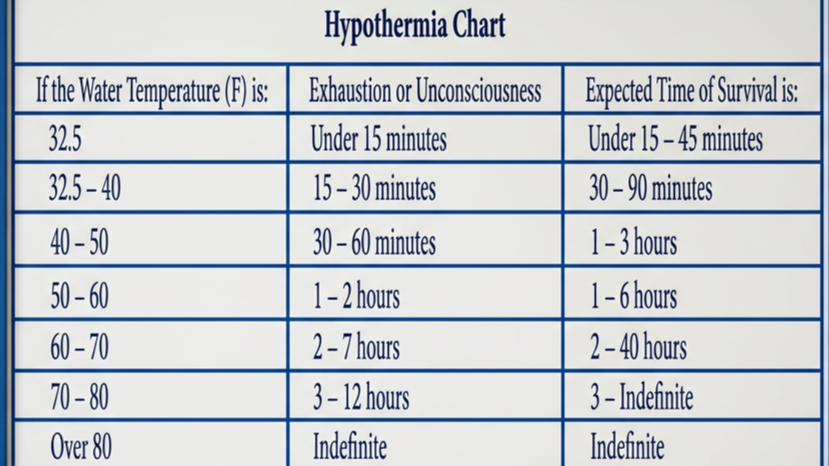
As you can see from the hypothermia chart (above), summer water temperature 70-80 degrees Fahrenheit can cause exhaustion and unconsciousness within three hours, and in the winter months, within two hours! The (lesser) time in this chart is assuming that you are without a life vest, and having to swim to stay afloat. Shelter becomes very important in this situation. You must get out of that heat robbing water (submersion in water whisks your body heat away 25 times faster than air). By climbing out of the water, either on a wing, an ice chest, or a liferaft, you will increase your survival chances by 70 percent! Stay with your aircraft (outside) as long as possible. If it sinks out from under you, it will not suck you down! You do need to be cautious of fuel in the water, which can cause irritation, and lines or cables that can wrap around your legs or body. You should list all your carried survival equipment on your flight plan as well as your 406 MHz registration form. By doing this, you increase your probability of detection and survival score, which could actually help lengthen your search time.
In the case of a water ditching, the life-raft will be your best friend. It will get you out of the water, it will increase your target size from the air, and it will provide you with survival equipment (if installed). If you are not able to get the life-raft out of the aircraft, do not re-enter the aircraft unless you have someone to hold your hand while reaching inside to retrieve a close-by life-raft. It’s the same analogy as the burning building. Most persons that re-enter a burning building typically do not return. There is some controversy about tying the life-raft to the aircraft. From my experience, most airplanes do not stay afloat for long depending on the circumstances. For instance, if you ditched because you ran out of fuel and if you perform the perfect water landing whereas you have no severe structural damage, your plane will float longer that one that has a full bag of fuel and is damaged on the landing. If you choose to tie your liferaft off to the aircraft, you can do it by using these steps:
Deploy (inflate) and enter your life-raft on the down-wind side of the aircraft (if possible), while being careful not to rub the liferaft against jagged edges.
While keeping an eye on the aircraft, and being ready to cut away should the aircraft start to sink, attach the 30 to 50 foot liferaft inflation lanyard (also known as the painter line) to the aircraft and allow the full length of the inflation lanyard to pay out by drifting downwind.
While drifting downwind, remove the lanyard from the liferaft by either un-clipping the snap-clip on or near the boarding ladder, or by cutting it.
Tie a loop in the end of the lanyard and hold on to it, making sure not to wrap the line around your hand or wrist.
If and when the plane starts to sink, simply let go of the lanyard.
Note: Liferafts have a 500 pound release point that allows them to break free should the liferaft get pulled down.
Signals: Obviously, to be rescued, you must be found. I have spent 20 years and probably well over 4000 hours sitting in the search window of Coast Guard aircraft looking for persons in the water. When you hear people say that it is very difficult to spot a Pilot In the Water (PIW), it is the truth. You, as a survivor, are responsible for attracting the attention of your searchers. If you fail to do this, you will extend your time of exposure. I cannot stress how important it is to carry survival equipment and especially signaling equipment on your person. Without a life-vest and signaling equipment, your head will be the only target, which is about the same size as a coconut floating in the water making the chances of being spotted by over-flying aircraft very slim. Technology has come a long way since my Coast Guard enlistment in 1973. One of the greatest things that has come out is the emergency positioning indicating radio beacon (EPIRB). The EPIRB has saved thousands of lives to date and with the latest technology, the 406MHz personal locator beacon with GPS, I would not leave home without it. When you deploy the antenna, and push the “ON” button, you are broadcasting your name, aircraft type, survival equipment, and Lat/Long position to your rescuers before they even leave the ground. Yes, they can be expensive $500.00 to $700.00 but it will be the best investment you ever made should you need it. Once the personal locator beacon (PLB) draws your rescuers to your vicinity, you can use other signals to bring them directly to you such as a signal mirror, sea dye marker, strobe light, etc. Also, be aware that the 406MHz PLBs will also broadcast on 121.5MHz, which will DF a searching aircraft or boat right to your position. In the water with no signaling equipment? Don’t despair, once you spot a searching aircraft or boat, cup your hands and throw as much water up into the air as you can. The water particles will catch ultra-violet light from the sun and shine like a thousand signal mirrors. This works well even in overcast days.
Water: I simply can’t overstate the need for having sufficient water. Next to hypothermia, dehydration is the most serious threat to survival. Think of your body as a water vessel filled to 70 percent. Once that level starts going down, you will start having problems such as thirst, dull mental state, depression, nausea, headache, and eventually death within 2-4 days. The perception that you should ration water is incorrect. You must stay ahead of dehydration. By the time you egress and get into the water, you will already be suffering a 4 to 6 pint deficit. Once you fall behind on hydration, it is very hard to catch up. Drink water if you have it, then use your renowned strength to build on the other seven steps to survival.
Food: Food is a feel good item in a sea survival situation. You can go about 2 weeks without food. It’s nice to have, but if you do not have water, it’s advisable not to eat it, as food uses a lot of stomach water to digest. Because long-term searches at sea are rare due to huge improvements in search and rescue (SAR) technology, I don’t feel it necessary to go into great detail about food. I place a fishing kit in my survival kit, but I really don’t think I will have time to pull it out and use it.
Play: The will to survive is every bit as important to survival as the previous six items. The term “play” refers to keeping a good mental attitude and constantly improving your survival posture. Think of your loved ones and fight to survive for them. Creating any recreational activity such as games, joke telling, or even praying will all contribute to maintaining an upbeat attitude. Don’t underestimate the importance of a positive state of mind. Keep yourself busy and use this step to go back and improve on the other six steps of survival by enhancing signals, water procurement, bailing water, stowing equipment, breaking out that fishing kit, and so on.